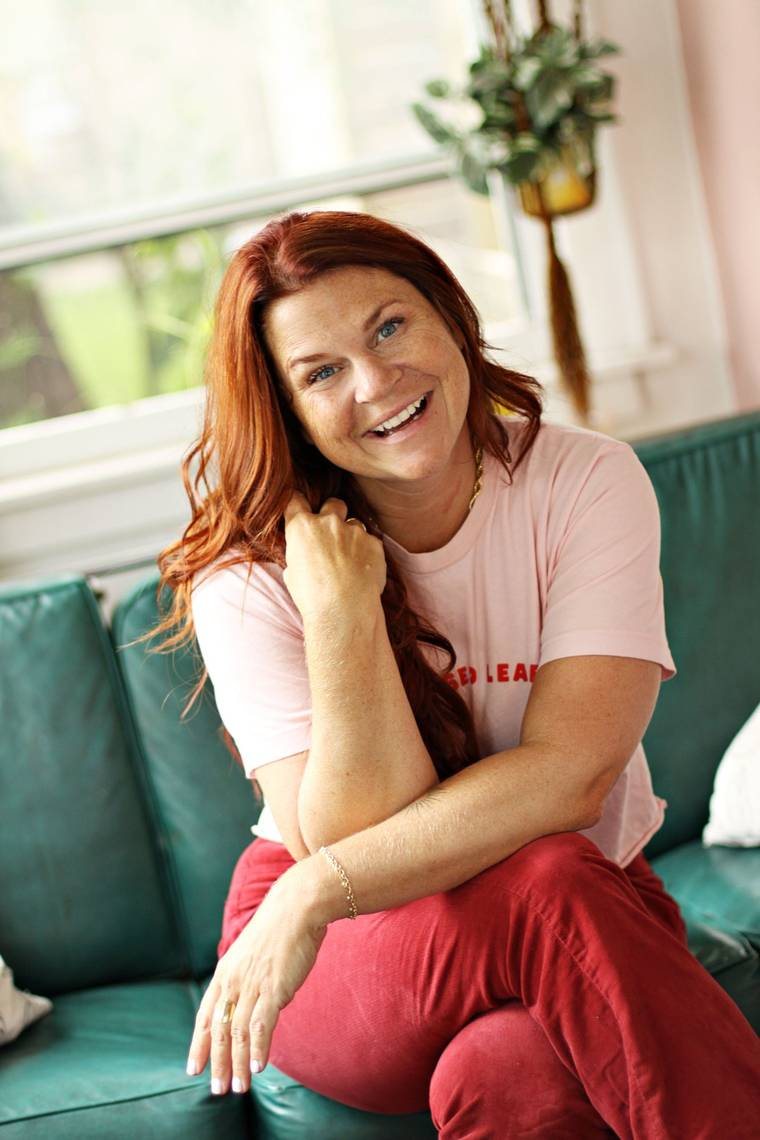
Professional development your teachers will be talking about for months.
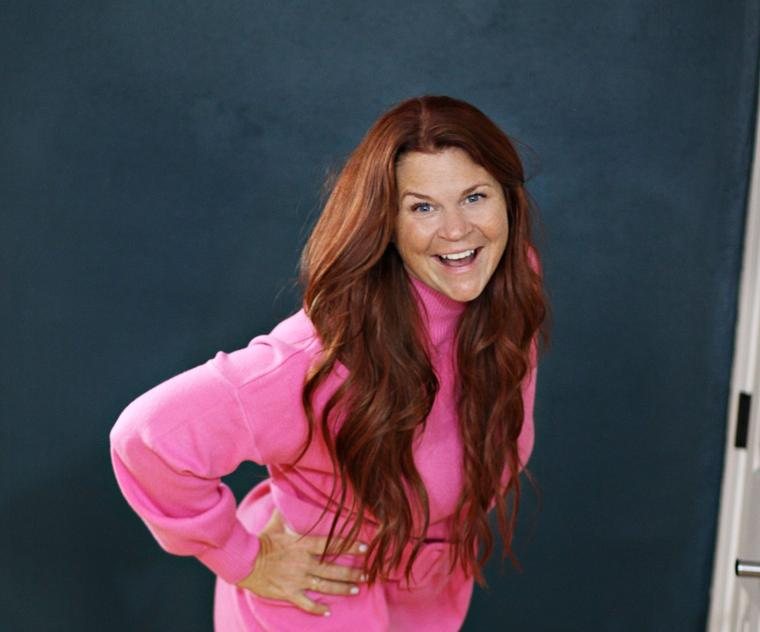
Kristen Day, author, podcaster, former early childhood educator, and your new play-based learning BFF. Kristen provides keynotes, trainings, and hands-on workshops that help early childhood educators shift from traditional practice to research-backed, play-based learning.
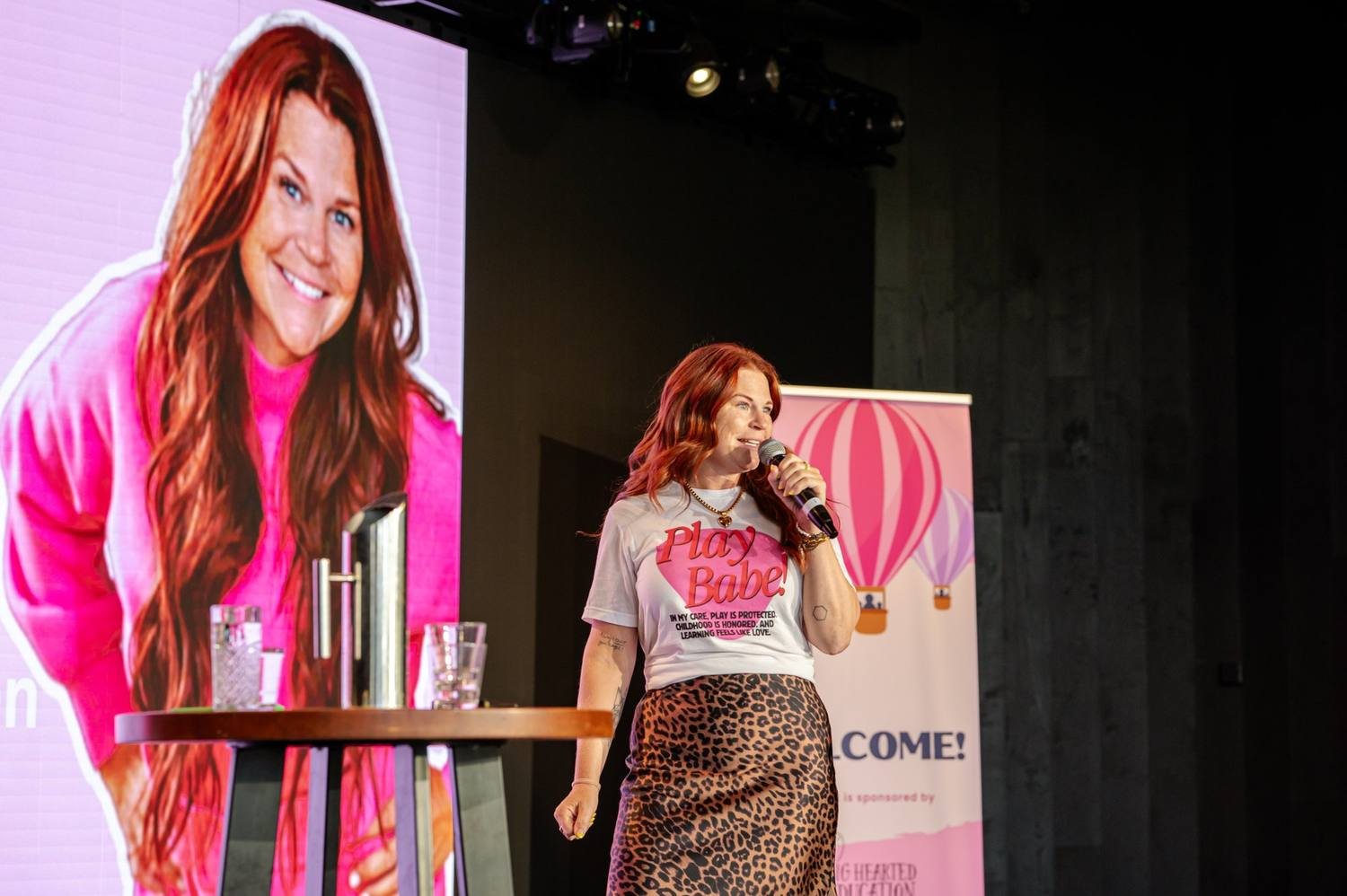
Kristen loves a room of eight just as much as she loves a room of 3,500. She holds the energy the same way either way, so no group is too big and none is too small!
Michigan AEYC · Texas AEYC · New York AEYC · California UPK Summit · Iowa AEYC · Northern Interior Alaska AEYC · North Dakota Family Child Care Association · Southern Utah Early Childhood Conference · Alabama Early Childhood Conference · SUNY Early Education Conference · University of Nebraska · The Learning Station Annual Conference · Georgetown Hill Early School Annual Conference · Coachella Valley Unified · Mt. Pleasant ISD · Grosse Pointe Public Schools · Elk River Public Schools · Itasca Area Schools Collaborative · Fort Leavenworth School District · Shasta County Public Schools · LBUSD Child Development Centers · Cincinnati Head Start · Episcopal School of Nashville · Crèche Day Schools · Antilles School, USVI · Del E. Webb Family Enrichment Center at Yavapai College
Plus hundreds more child care programs, early childhood conferences, Head Start programs, and school districts across the United States, Canada, Mexico, South Africa, and Australia, since 2018.
where doyou fit?
Conference or association
More than one school or organization in the room. Most conferences do a keynote for everyone plus a few breakout trainings, and some add a hands-on workshop. We will work to build it together!
District or school system
Your own staff, your own PD day. A keynote plus breakout rotations, two workshops, or a mix of everything. Seven hours to use however it serves your teachers.
Child care program or preschool
No group is too small! Kristen loves working with small programs, because a small program is exactly where she started. Most centers pick two trainings or one hands-on workshop, and she will help you work out what your team actually needs.
This is just a snapshot of what Kristen does. There is much more detail further down the page, and whichever one you are, we will make a great day together!
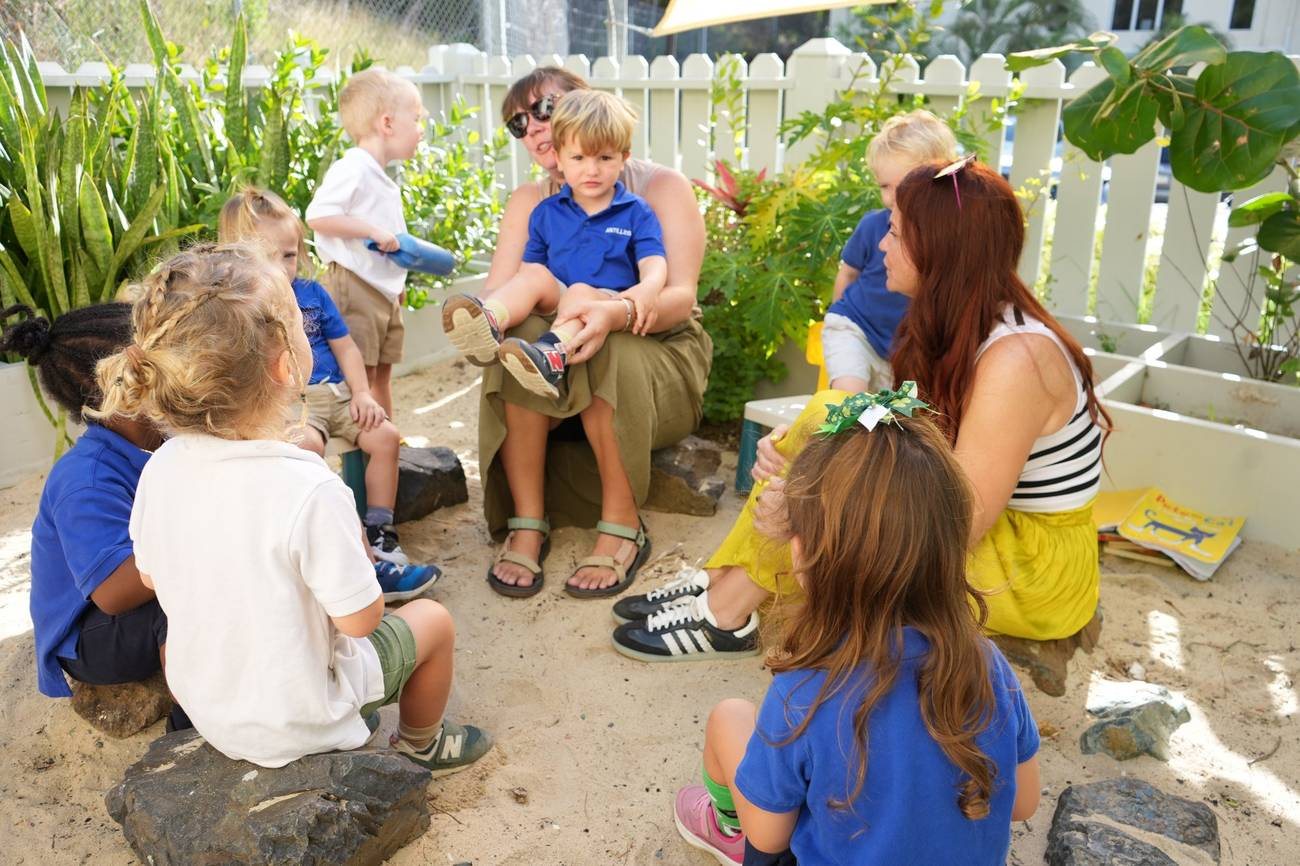
before the stages,she built the preschool
In 2014 Kristen founded Butterfly Hill Nature Preschool, the first play, nature, and forest school in central Minnesota. Mud pies as gourmet cuisine, sticks as wands, and childhood always reigning supreme.
Behind that were seventeen years in early childhood. Family child care in her own home, public school kindergarten through second grade, a traditional preschool, and then the play-based preschool she built herself. She has done the job you are doing, in the rooms you are doing it in, with the same licensing binder and the same tired feet at the end of the day.
Everything she teaches is grounded in early childhood research and in what she learned living it, day after day, alongside real children. Since 2018 she has been sharing those same methods with tens of thousands of early childhood educators.
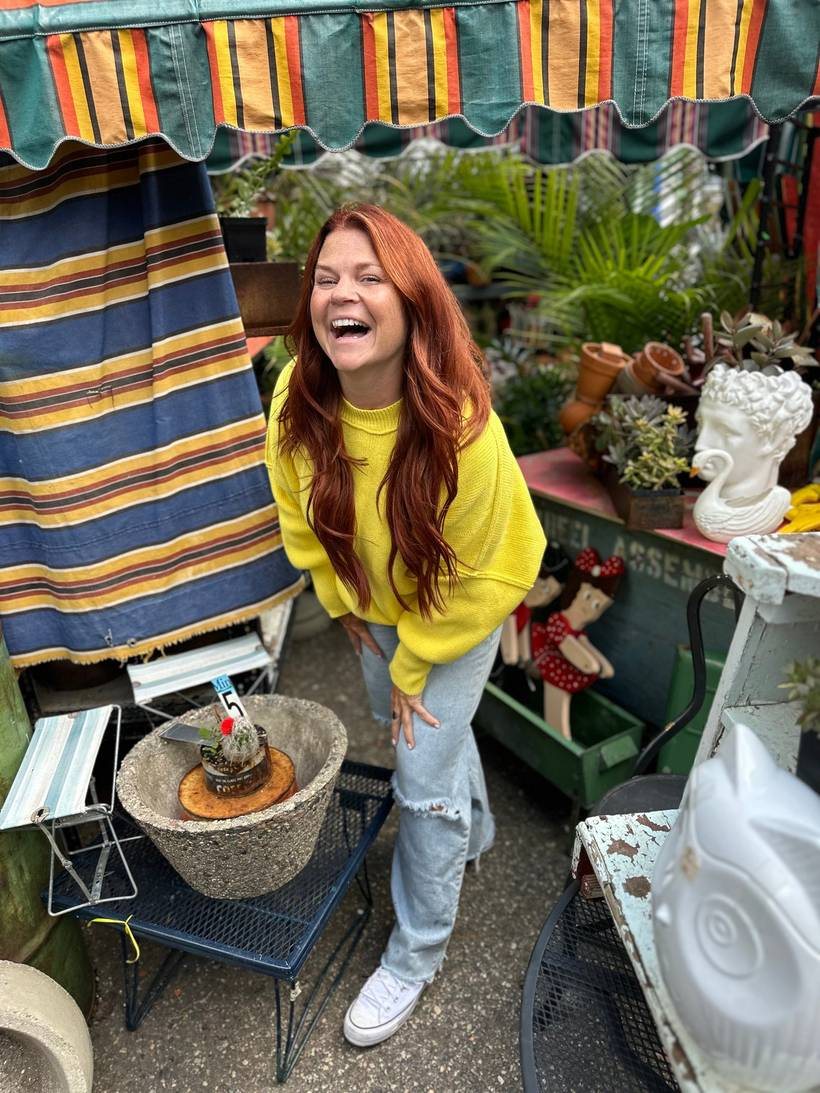
meetKristen
Kristen Day is a keynote speaker, author of I’m Not Getting Them Ready For Kindergarten, and host of The Play Based Learning Podcast. She holds a B.A. in Elementary and Early Childhood Education, and she ‘retired’ from teaching to travel and work with educators instead.
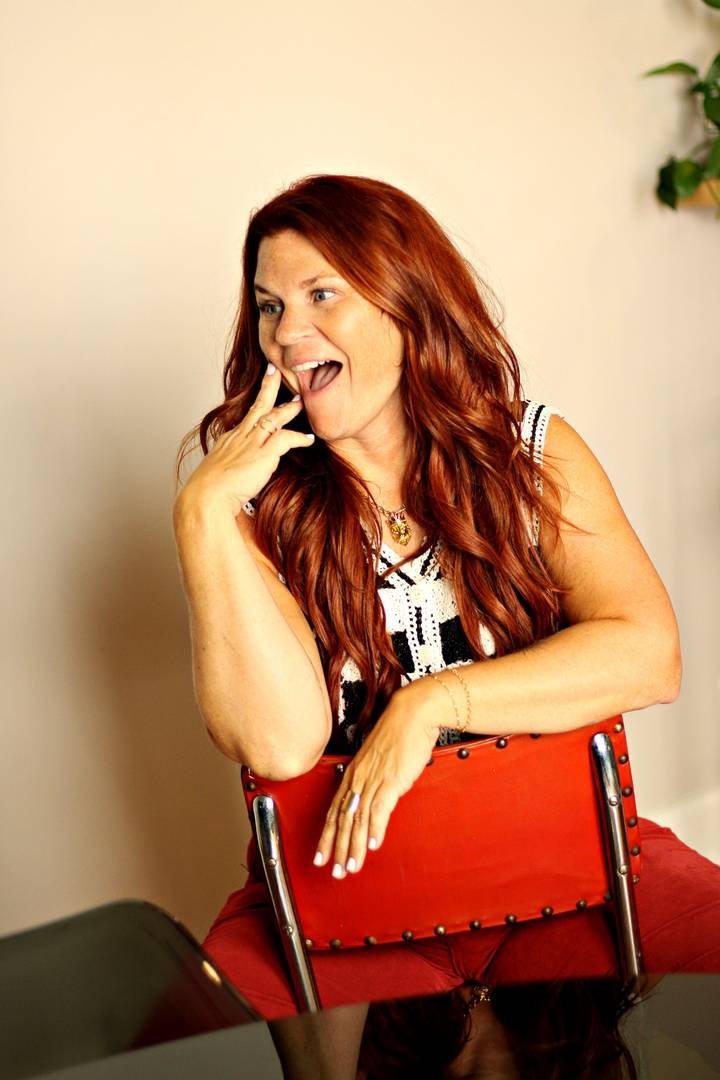
On stage she is funny, dramatic, and real. Her style gets described as a conversation with a best friend, and she tells stories that apply to the life of any early childhood professional.
She is the Lorax of early childhood education. She is there to speak for the children, and she leaves the room motivated to stand up for childhood.
Also: mom of four, donut enthusiast, book hoarder, and a travel junkie who thinks every airport latte tastes better on the way to someplace new.
Full bio, headshots, and press kit
The Play Based Learning Podcast. Pick any episode that sounds useful and listen on the way to work.
one day with Kristen,how will you spend your seven hours?
One day with Kristen is up to seven consecutive hours, lunch and scheduled breaks included. Use it however it serves your event. A keynote for everybody, a stack of breakouts, one deep workshop, or a mix of all three.
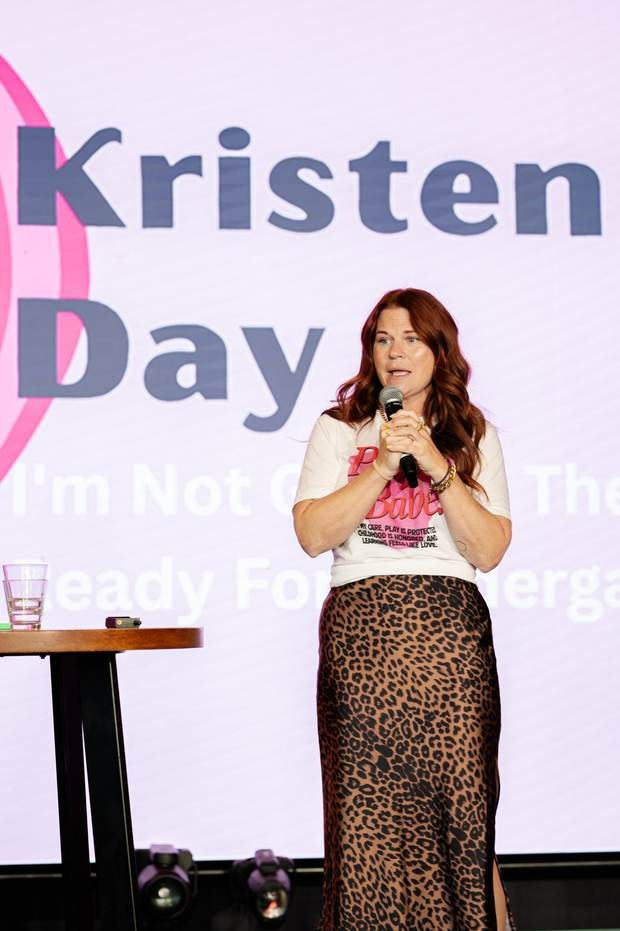
Keynote
This is the session that changes the temperature of the room. A keynote exists to shift how people think, and Kristen is after one shift in particular: childhood seen through a child-centered lens instead of a control-based one. Big ideas, personal stories, and a room that leaves fired up. Best for opening a conference or a PD day.
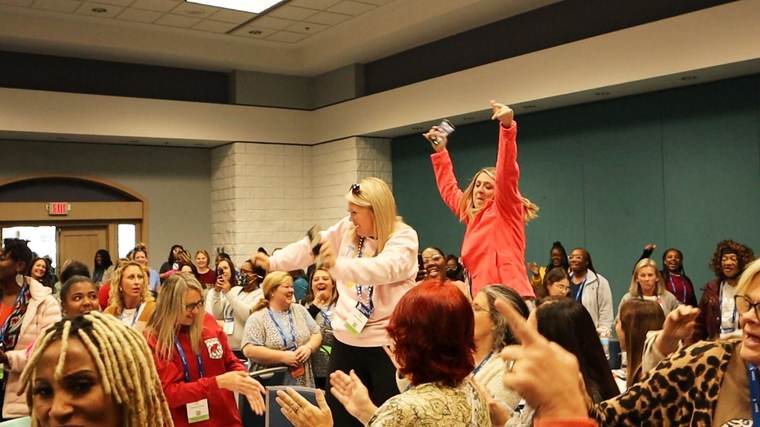
Training
Instructional and story-driven. Attendees leave with concrete strategies for Monday morning. Needs a projector and a screen, nothing else. Best for breakouts and staff development days.
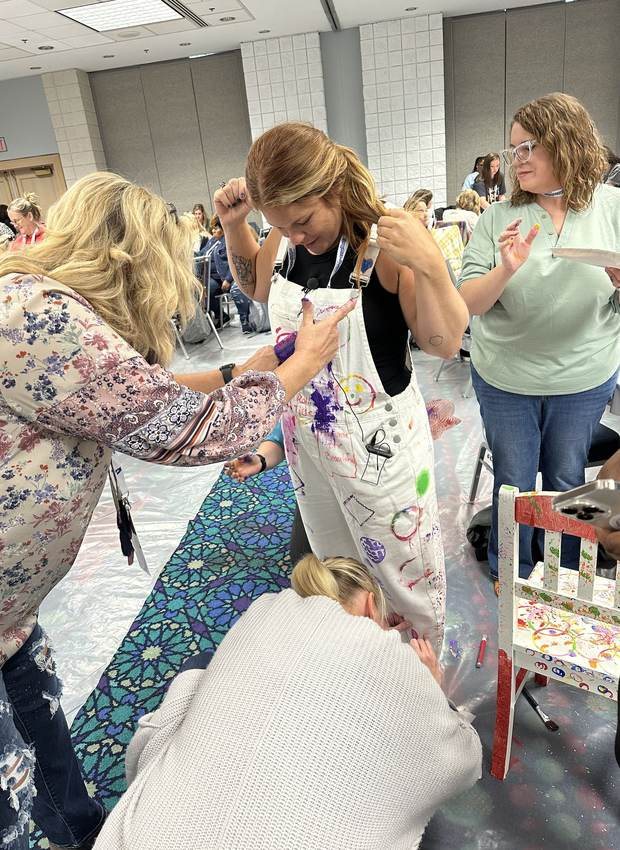
Workshop
Hands-on and messy in the best way. People touch real materials and make real things. Every workshop has its own requirements, listed on each session below.
When Kristen has the room all day
A full day is not just three sessions stacked on top of each other. Kristen threads songs the teachers can take straight back to their own circle time, new book ideas, and games to keep the energy up between sessions. Holding a whole room for seven hours is its own skill, and it is the part planners tell her they did not expect.
Have a peek at the session requirements before you plan your schedule
The hands-on workshops each ask for something a little different, whether that is setup time, a certain room arrangement, or a couple of tables. It is all listed with each session below, and we will walk through every bit of it together on our planning call.
Group size matters too! Some workshops work beautifully with up to 200 people, and some are at their best with under 50. Kristen will talk through what fits your event size before anything gets locked in.
here is the wholemenu of options
These are Kristen’s most popular sessions. If none of them quite fit, she will either suggest a better match or build something with you for your specific group.
We will lock in which sessions you would like six to eight weeks out, or earlier if your conference or school needs it, or on our very first Zoom if you already know exactly what you want.
We step back from the rush of modern childhood and ask one question. What happens when we stop?
Press Pause is research and heartfelt stories about uninterrupted, child-led play, and what it builds in a child that nothing else builds. Creativity. Problem solving. The ability to sit with a hard feeling without falling apart.
Kristen makes the case for a slower childhood, the kind most people in the room remember having, and sends teachers back inspired to protect a little more stillness in their own classrooms.
They walk away with
- Language for defending play to a parent, a principal, or a skeptical coworker
- A clear picture of what uninterrupted play actually looks like
- Permission to protect it out loud
What we need from you
- Projector, large screen, audio, wifi, lapel mic.
A bold reframe of what it really means to prepare a child for school. Rather than rushing into academics, Kristen believes in getting children ready for kindergarten by letting them fully experience being 3, 4, and 5 years old.
Together we explore the critical role that play, wonder, and child-led exploration have in building the foundation for all future learning. Kristen shares how this approach lines up with children’s developmental needs and actually sets them up for greater success in school, by growing creativity, problem solving, and emotional resilience. We all know the very best way to prepare a child for kindergarten is to let them be exactly the age they are.
It shares a title with her book, so it pairs well with a book table. Books can be brought in for your event at no extra charge. Kristen just needs to know roughly how many you would like at least eight weeks out so she can order and plan ahead.
Alternate title for your program
Some committees would rather not print a title that opens with a negative. Same session, same content, same argument, listed as They’re Already Getting Ready instead. Just tell us which one you want on the agenda.
They walk away with
- A reframe of readiness they can take to a curriculum conversation
- The developmental case for letting 3s be 3
- Reasons to stop apologizing for a play-based program
What we need from you
- Projector, large screen, audio, wifi, lapel mic.
Say no to everything and eventually nobody comes running. That is the trouble with a reflexive no, and it is exactly why the fable fits.
This session is about saying yes in a different way. Yes to a child’s curiosity. Yes to their wonder. Yes to the need underneath the behavior, which is often as unglamorous as an itchy tag, a full bladder, or a child who does not yet trust the adult in the room.
Here is the uncomfortable part. Most of the time the no has nothing to do with the child. It is about what is inconvenient for us in that moment, and every reflexive no quietly takes a real learning opportunity away.
When children get long, genuinely uninterrupted stretches of play, a surprising number of those behaviors simply fade, because we are finally developing the whole child instead of managing them. Attendees leave knowing how to say yes far more often, and how to make the no that really matters actually land.
They walk away with
- A method for converting a reflexive no into a workable yes, so the real no still carries weight
- Maslow applied to a real classroom instead of a textbook one
- Ways to spot the unmet need under the behavior
What we need from you
- At least 4 sheets of large easel paper
- Projector, large screen, audio, wifi, lapel mic.
But we’ve always done it that way. It is the sentence that ends a conversation about change before it starts, and almost everyone in the room has either said it or had it said to them.
So this session takes it seriously. Calendar time. Weather reports. Letter of the week. Criss-cross applesauce. Kristen brings the research on why letting these traditions go produces a calmer, happier room for the children and for the adults, then sits in the discomfort with the audience instead of standing outside it.
Kristen is speaking from experience here rather than from a podium. She did every single one of them. Calendar time, weather reports, letter of the week, criss-cross applesauce, the lot, and went home with a headache every single day from the sheer amount of control those routines take to run.
Expect honest reflection. Expect some squirming. Expect people to find you afterward and tell you it was the session they needed.
Full title for your program
But We’ve Always Done It That Way: Breaking Tradition in Early Childhood Education
Booking note: best placed after a keynote rather than cold first thing in the morning. It asks a lot of the room.
They walk away with
- The research behind why these routines fail developmentally
- Replacements for each one that take less prep than what you are doing now
- A way to talk to a resistant coworker about it
What we need from you
- Projector, large screen, audio, wifi, lapel mic.
Literacy learning does not require letter of the week.
Kristen shows how storytelling, sensory play, and a well-built environment grow vocabulary, letter recognition, and phonemic awareness while children are busy doing something they chose.
Attendees leave with specific setups they can build Monday using what is already in the closet.
They walk away with
- Environment setups that grow literacy without a worksheet
- The difference between letter exposure and letter instruction
- Read-aloud and storytelling moves that do real work
What we need from you
- Projector, large screen, audio, wifi, lapel mic.
Early math does not require worksheets or calendar time.
Blocks. Water. Sorting the good rocks from the boring rocks. Kristen shows what a math-rich room looks like and how to name the math already happening in it, which is considerably more of it than most teachers realize.
Number recognition, patterning, comparing, counting, problem solving. All of it underway before anybody plans a lesson.
They walk away with
- A math-rich environment they can set up with existing materials
- Language for naming math in play, out loud, in the moment
- Provocations that invite counting and comparing without a prompt
What we need from you
- Projector, large screen, audio, wifi, lapel mic.
Flashlights, projectors, light tables, light-up scrunchies, submersible ice cubes.
Kristen connects light to sensory exploration, play schemas, self-regulation, and inquiry, then hands over budget-friendly ways to get it into a room this week.
Attendees walk out with far more light play ideas than a light table, and most of them use materials a program already owns or can pick up cheaply.
They walk away with
- How light play supports sensory exploration, inquiry, and self-regulation
- Light-based materials matched to the play schemas they support
- A light play area they can assemble from low-cost, readily available materials
What we need from you
- A room you can dim
- 30 minutes to set up her light materials
- Projector, large screen, audio, wifi, lapel mic.
Ask ten teachers in one building what play-based learning means and you will get ten different answers, and at least three of them will be a worksheet with stickers on it.
This session fixes that, gently. It is photos and video of real children in real play, and the whole room walks through them together. What is happening here? What is this child working out? Where is the math, the literacy, the negotiation, the risk assessment?
Along the way Kristen covers how much play children genuinely need in a day, what whole child development looks like inside a play-based environment, and the hardest part for most of us, which is letting go of enough control for children to take over their own learning.
Book this one first if your team is not on the same page yet. It is the baseline that makes every other session land.
They walk away with
- A shared, staff-wide definition of what play actually is, and what it is not
- The ability to spot real learning inside play they used to walk past
- A realistic picture of how much play a young child needs each day
- Permission, and a plan, to release a little control
What we need from you
- Projector, large screen, audio, wifi, lapel mic.
Somewhere along the way outside became recess. Twenty minutes, a jungle gym, a whistle, and back in we go.
Kristen built a nature and forest school, so she has spent years watching what happens when the outdoors gets treated as a classroom instead of a break from one. This training makes the case for why outdoor play is necessary for growth and development rather than a reward for finishing the real work, and then gets practical about how to get there.
Most programs are working with a commercial playground and a fence, and that is fine. You do not need acres of woods. The session walks through what you can add to the space you already have, the kind of open-ended materials and provocations that turn a flat playground into somewhere children get curious, take risks, and wonder out loud.
The goal is simple. Give children back the outdoor time most of us had as kids, and stop apologizing for how much of it they need.
They walk away with
- The developmental case for outdoor play, ready to make to a parent or a principal
- A reframe of recess as outdoor classroom time
- Practical additions to a standard commercial playground
- Ways to move indoor learning outside without buying anything new
What we need from you
- Projector, large screen, audio, wifi, lapel mic.
Rotating between a math center, a science center, and a literacy center is the default in early childhood. This workshop puts something more powerful in their place.
For the first stretch, attendees are inside real play setups Kristen builds in the room. The adults actually get to play, and they have an absolute blast doing it, which is not something most of them have done in a professional development session before.
Then the detective hats go on and the group works together to name the math, science, literacy, and social learning that just happened in front of them, which turns out to be most of the standards they were worried about missing.
Three hours is the version Kristen recommends, though it can be tightened to two if your schedule is packed. This is one of her own favorites and the workshop she gets asked for most. It is the session people describe afterward as the one that changed how they see their own classroom.
They walk away with
- Play setups that replace centers entirely, ready to build
- Practice naming standards inside play, with their own state document in hand
- Kristen’s documentation bundle for connecting learning to play
Included for every attendee
Digital documentation bundle, delivered the day of the workshop.
What we need from you
- 45 minutes of setup in a room free of attendees. This time counts inside the seven-hour day.
- One person designated to help Kristen during setup
- A water source and sink nearby for prep and cleanup
- A room with at least 10 tables
- Supplies from a list we send 30 days before your event: easel paper, paint, chia seeds, Ivory soap, and cleanup basics
- One printed copy of your state, province, or country early learning standards. If you’d like a condensed version, Kristen has created one for every state.
- Projector, large screen, audio, wifi.
Play gets dismissed because it does not produce a worksheet, or any other tangible receipt for the learning that just happened. This workshop fixes the documentation problem instead of arguing about it.
Attendees get to know their own state’s early learning benchmarks, then apply them to real video of real children playing. They practice naming the learning out loud, and they practice writing it down in a form an administrator or a parent will actually accept.
Book this one when your teachers already love play and cannot yet defend it.
They walk away with
- Fluency in their own state’s benchmarks
- A documentation method they can run the following week
- Evidence-building practice, using real video
Included for every attendee
Kristen’s documentation swag bag. PDF and Google Drive resources, over $100 of materials.
What we need from you
- Your state, province, or country early learning standards printed for every attendee. These are a different document from your licensing requirements. If you’d like a condensed version, Kristen has created one for every state.
- Projector, large screen, audio, wifi.
It starts with an ordinary object in your hands. Kristen hands out random items and asks the room to come up with fifty different ways a child might use that one thing in play. Fifty ways a child would actually use it, rather than fifty teacher-directed activities. It is harder than it sounds, and it wakes up creativity most adults have not stretched in years.
Then the cabinet comes out. Kristen travels with a cabinet of open-ended materials and goes through it piece by piece, though not to tell you what anything is for. That is the point. A wooden block is the original loose part, and in a child’s hands it becomes a cell phone, an ice skate, a hamburger, a walkie-talkie. A plastic toy hamburger will pretty much always be a plastic toy hamburger.
So the work here is getting into a child’s brain instead of an adult’s, and seeing how the most random materials, the ones you would never think of as play materials, become the catalyst for enormous amounts of creativity and learning. A photo showcase of many more loose parts follows, all things you could start collecting tomorrow.
The last stretch is play schemas. What they are, how to spot them, and exactly what to add to your environment to support each one. Once you can name a transporting schema you stop calling it a mess.
They walk away with
- A creativity workout that changes how they look at ordinary objects
- Loose parts setups that cost almost nothing
- The play schemas, how to spot them, and what to add to support each one
- An ebook with more than 30 curiosity ideas
Included for every attendee
Ebook with over 30 ideas for sparking creativity and curiosity.
What we need from you
- 30 minutes of setup, preferably in a room free of attendees
- One banquet table, 6 to 8 feet, at the front of the room
- One large pad of easel paper. Post-it Super Sticky, 25 x 30 inch.
- Projector, large screen, audio, wifi.
Preschool art should look like curiosity rather than conformity. Twenty identical paper plate turkeys are not an art program.
Kristen makes the developmental case first. How open-ended art builds creativity, executive function, problem solving, confidence, and motor development, and why crafts quietly limit thinking. When children are free to explore materials their own way, they take risks, test ideas, communicate feelings, and express themselves in ways no adult-led craft ever captures.
Then it gets practical. How to set up invitations that honor children’s natural curiosity, how to support exploration without over-directing, and how to handle materials, setup, and classroom flow, because the mess is the reason most teachers quit trying.
There is a hands-on component built in, where attendees stop listening and actually make their own art. Process art, the real kind, with no right answer waiting at the end of it.
They walk away with
- A clear understanding of why process art matters, ready to explain to a parent or an administrator
- How to set up invitations without over-directing
- Practical answers on materials, setup, and classroom flow
- 52 process art invitations, a full year of them
Included for every attendee
This Is Not a Craft Book, Kristen’s downloadable book of 52 process art invitations.
What we need from you
- 45 minutes of setup in a room free of attendees
- Enough table space for every attendee to work with materials
- One banquet table, 6 to 8 feet, at the front of the room
- Kristen brings all the materials for the process art provocations!
- Projector, large screen, audio, wifi.
This one starts before circle time even happens. How do you set up a morning that actually fits what children need, with the fewest possible transitions, since transitions are the hardest part of a young child’s day? How do you build community in the morning without defaulting to a morning meeting?
From there, Kristen says goodbye to the YouTube good morning song, calendar time, and the weather chart nobody in the room is invested in, and brings circle time back to what it was supposed to be. A short, joyful gathering that respects the attention span of an actual three-year-old.
Her favorite read-alouds. Old-school finger plays and movement songs. How to build a story basket, plus a pile of ideas for making your own. If circle time currently feels more like crowd control than connection, this is the permission slip to do it differently.
They walk away with
- A morning routine built around children’s needs, with far fewer transitions
- Ways to build community that are not a morning meeting
- A circle time structure that fits real attention spans
- Finger plays, movement songs, and read-alouds they can use tomorrow
- How to build a story basket, and ideas for a dozen more
Included for every attendee
The Retro Circle Time ebook, with every idea from the session.
What we need from you
- 30 minutes of setup, preferably in a room free of attendees
- Projector, large screen, audio, wifi.
Somewhere along the way we became dot-dot-not-a-lot teachers, rationing glue by the drop and calling it a lesson in responsibility. It was never about the glue. It was about control.
This workshop is Kristen’s case for saying yes to glue play, and it gets very practical very quickly. How children learn for themselves what too much glue feels like. How to contain the mess so it fits what you can actually cope with. How to set up a glue table or a dedicated glue space without blowing your materials budget, and how to make a glue stash stretch much further than you think.
Underneath it all is the bigger conversation about where adult need for control shows up in our work with children, usually without us noticing, and what it costs them.
Hands-on throughout, and every attendee leaves with the Free the Glue ebook, packed with ideas and materials to use straight away.
They walk away with
- Why glue play matters, in developmental terms they can explain to anyone
- A glue space they can set up economically
- Mess strategies that make it survivable
- A sharper eye for where adult control is creeping into their room
Included for every attendee
The Free the Glue ebook, packed with glue play ideas and the materials to use.
What we need from you
- 45 minutes of setup in a room free of attendees, with a water source nearby
- Enough table space for every attendee to work
- One banquet table, 6 to 8 feet, at the front of the room
- Access to outlets for the glue guns, plus at least two power strips
- Kristen brings every other supply!
- Projector, large screen, audio, wifi.
Children build weapons out of sticks. They smash block towers like a tiny demolition crew. They hold a funeral for the doll that did not make it. Then the adults freeze, redirect, and whisper it to each other across the room. Is this okay?
Those weird, wild, faintly unsettling moments are essential. They are how children process risk, power, mortality, and destruction, all the things we usually keep locked up tight. This session is a permission slip to get curious about the Big Five instead of panicky: risky play, weapon play, rough and tumble, death and dying play, and violent or destructive play.
Kristen covers why each one is developmentally appropriate and necessary, then gets practical about supporting it inside real boundaries, including the public school no-weapon-play reality and exactly what to do instead.
Here is what makes the in-person version different. Attendees do the teaching. The room splits up and teaches each other through skits, puppet shows, game shows, and collaborative art pieces. Nobody sits and listens for two hours, and nobody forgets what they taught.
They walk away with
- A whole new lens for seeing scary play as necessary rather than naughty
- The developmental case for each of the Big Five
- Ways to support each type inside the boundaries their setting actually has
- Language for explaining all of it to a nervous family member
Included for every attendee
The tactical toolkit. A digital ebook and training resources, ten research receipts, five wall prints for the classroom, five info sheets to hand families and stakeholders about why each type of play matters, and Kristen’s risk benefit assessment form.
What we need from you
- 30 minutes of setup, preferably in a room free of attendees
- Room for small groups to spread out and work
- Kristen brings everything the small groups need!
- Projector, large screen, audio, wifi.
let’s send your attendees homewith some swag
Most of Kristen’s workshops come with digital resources for every single person in the room. There is no extra charge and no per-head fee.
These are the same resources Kristen sells in her virtual shop, but your teachers get them included! It is worth factoring into what you are really getting for your investment.
what people have said
Your passion was contagious. Your delivery was captivating. Your visuals were beautiful. You owned the room. All 2000 of them!
Heather Lucas President, Michigan AEYC Governing Board
State association keynote, 2,000 attendees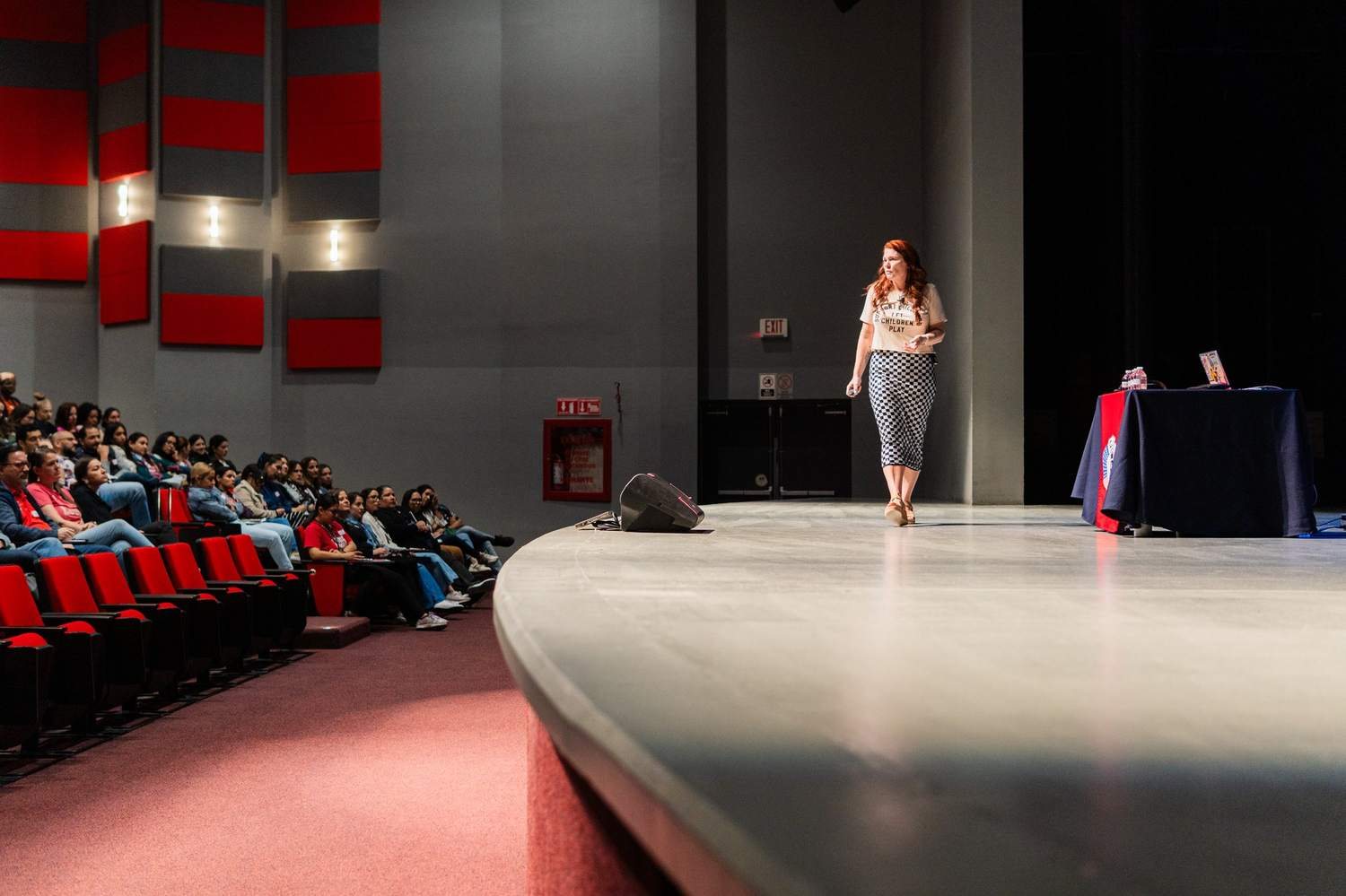
Attendees walk away from her presentations feeling inspired, with their passion either ignited or reignited. I know this to be personally true as she has presented to our teaching staff and school district administrators on several occasions over the past few years. Each time our staff walks away wanting more. Teachers and administrators now refer to her as the early childhood guru. I promise you, she will not disappoint.
Jean-Mari Dagarin, MS.Ed Coordinator of Early Learners, Coachella Valley Unified School District
Kristen Day’s training session was truly a game-changer for our team! What impressed us most was how practical, actionable, and relevant her insights were. We watched our teachers return to their classrooms energized and excited, ready to implement new routines, strategies, and ideas right away. Seeing that immediate shift from professional development to confident action was incredible. If you’re looking for a professional development speaker who energizes a team, inspires meaningful change, and gives educators strategies they can immediately take back to their classrooms, Kristen is truly exceptional. We cannot wait to have her back!
Beth Heil Director of Recruiting & Development, Crèche Manhattan
The best early childhood professional development I have ever seen. Kristen’s passion, knowledge and upbeat personality shined!
Andrea Hallborn Preschool Teacher, Dallas, Texas
My notes page is FULL of valuable pieces of gold from this hour.
Monica Anderson Conference Attendee, Portland, Oregon
I was totally blown away! I could just keep listening to her!
Shantel Michaels Conference Attendee, Alabama
I thought your keynote was phenomenal. You spoke to my soul.
Heather Lucas President, Michigan AEYC Governing Board, 30+ years in early childhood
theinvestment
Everything below includes travel, lodging, and all the planning time. Handouts and workshop supplies are not included, and neither are before or after conference networking events. Ask if you would like Kristen at one of those and we will quote it.
Private events
One center, preschool, or district speaking to its own staff.
| Continental USA, one day | $7,000 |
| Continental USA, two days | $10,000 |
| HI, AK, Canada, Mexico, one day | $8,000 |
| HI, AK, Canada, Mexico, two days | $12,000 |
Conferences
Any event involving more than one school, organization, or entity.
| Continental USA, one day | $8,000 |
| Continental USA, two days | $11,500 |
| HI, AK, Canada, Mexico, one day | $9,000 |
| HI, AK, Canada, Mexico, two days | $14,500 |
Minnesota Nice
Half day within 140 miles of Alexandria, MN. Usually two trainings or one workshop.
International
One day, travel and lodging included. Add a second day for $6,000.
Virtual training
Any training on this page over Zoom, 75 to 90 minutes.
A quick Zoom meet and greet, under 30 minutes. Bring every question you have.
The Play-to-Standards Framework™for programs that want more than a PD day
A great keynote moves a room, but it does not change a whole system.
Most programs already believe in play. The problem is never belief, it is implementation. Every teacher runs their classroom a little differently, whether that is a public school or a child care program with twenty rooms and no shared play philosophy. Teacher-directed activities get counted as authentic play. Outdoor time gets treated as recess instead of instruction. Documentation drifts away from what is actually happening with children.
Then accountability pressure arrives and play becomes something teachers have to justify rather than something everyone understands.
Kristen created the Play-to-Standards Framework™ to fill this gap. It is six pillars, built for school districts, child care programs, and private preschools alike, that give leaders a shared definition of play and give teachers a documentation system that holds up. Everyone gets trained the same way, on the same framework, so play means the same thing in every room.
District leaders, principals, and curriculum directors, plus child care directors and private preschool owners. Anyone leading a team of teachers who has decided play is not negotiable and needs everyone on the same page.
How do we know our children are ready for kindergarten?
The framework is built so a leader can answer that with authentic evidence gathered during play, rather than a disconnected checklist.
The framework is none of these: a set of centers, activities, or lesson plans; a checklist; or a replacement for standards. Above all, it is the opposite of a one-day PD session with no follow-up, and that is the biggest difference between this and a single professional development day.
nothing here fittingyour budget?
Travel and lodging are already baked into every fee above, so there is nothing hidden to budget around. If the number still does not work this year, there are three other ways to get Kristen in front of your teachers.
Virtual PD Experience
A series of virtual professional development experiences your team can join live.
Recorded trainings from Kristen’s store
Kristen’s most requested trainings, recorded and ready for your own PD day, PD certificate included. Most run around $47 per person. Buying for a whole team? Email Kristen first and she will set up group pricing for your program.
One live virtual training
Any training on this page, live over Zoom, 75 to 90 minutes.
Still not sure what fits? Say so on a meet and greet. Kristen has built around a tight budget plenty of times, and if nothing here works she will tell you straight rather than string it out. Grab a slot
how bookingworks
We meet
Kristen will very likely sing you into the Zoom room, and that tells you most of what you need to know. This is a short call to find out whether our energy matches. She wants a feel for your event and your people, you get a feel for her before anybody signs anything, and you bring every question you have.
You lock the date
A 50% deposit and a signed contract hold the date on Kristen’s calendar. The deposit applies to your balance.
We plan, 6 to 8 weeks out
A Zoom to walk the rider line by line and confirm sessions, venue, AV, travel, and attendee count.
Supplies and final invoice
Your supply list and final invoice arrive 30 days before the event, so you can have everything ready and waiting at the venue for the big day! Every session’s requirements also live right here on this page anytime you want a peek.
The day
Kristen arrives 45 to 60 minutes early. Your AV person meets her. Then she does her thing.
everything you needto plan your event
Click on whatever you need for your event. Each one opens as a page you can read, print, or save as a PDF. No form, no email required, and no waiting on Kristen to send it over.
- Speaking magazineA condensed version of the fees and sessions, easy to forward to the powers that be.Open
- Speaker riderThe document we go through together six to eight weeks out, so Kristen can give your people 110% on the day.Open
- Session requirements and supply listsWhat to have ready for each hands-on session, broken down session by session. Hand it straight to whoever does your ordering.Open
- Bio and stage introductionThree bio lengths, plus an intro script set large enough to read from a lectern.Open
- Marketing materialsHigh-resolution photos and the logo for your program, website, and socials.Open
- Promo copyDescriptions of every session already written, short and long, plus a speaker bio and social captions. Copy and paste them straight into your program and your emails.Open
- Session objectivesAll of the objectives for every session, written for your CEU and state approval paperwork.Open
- W-9For your finance office, so nobody has to chase Kristen for it.Open
the questionsplanners ask
What does the fee cover?
Travel, lodging, and all planning time. Handouts, workshop supplies, and networking events are separate.
How does payment work?
Two invoices. A 50% deposit at booking, and the balance due on or before the event date. The final invoice goes out 30 days ahead.
Forwarding it to whoever holds the budget is the booking party’s job, and school districts often need real lead time to cut a check. A late balance adds $500.
Can we record her?
Short clips for social media, absolutely. Full recording of a keynote or training gets arranged at booking, with its own fee and its own agreement.
Do attendees get the slides?
No. Session objectives are provided free for CEU and state approval. Slides stay with Kristen.
What about CEU and state approval paperwork?
Session objectives are free. If you need Kristen to become an approved trainer in your state, or you have forms beyond objectives, that work is billed at $250 per hour.
What tech does she need?
An AV person who knows the room, meeting her 45 minutes before she starts. She brings a Mac, an adapter, and an HDMI cord. Everything else comes from the venue.
She needs wifi and a lapel mic, and her slides run in Canva, so flag it early if that site is blocked at your location.
Can she just use the mic at the podium?
Kristen is a mover and a shaker, so a podium mic will lose her about four seconds in. A lapel mic is really the only thing that works, and it frees up both hands, which she talks with.
Can she sell books at our event?
Yes, and she would love to. There is no extra charge for it, and Kristen is happy to do a signing afterward, which attendees tend to line up for.
She just needs to know roughly how many books you would like at least eight weeks in advance so she can order ahead. Anything over 50 books ships straight to the conference center rather than traveling with her.
How far ahead should we book?
It comes down to what is already on Kristen’s calendar. The popular stretches fill up early, and August is the big one, so six to eight months out is the safe bet for those.
Reach out anyway, because your date might be wide open. With about a month of notice, a virtual session is usually the realistic option. With three months or more, in person is generally no problem at all.
How many people can be in a workshop?
It depends on the workshop. Some of them work great with up to 200 people, and some are at their best with under 50.
Bring your expected headcount to the Zoom, and Kristen will help you match a workshop to your group size.
What if we want something that isn’t on this list?
Bring it up on the Zoom. Kristen will either suggest a better fit from the list or build something with you for your specific group.
let’s find outif this is a fit
Grab a spot on Kristen’s calendar. We will have a short Zoom meet and greet to see if we are the right fit for each other, then go from there. Come with your questions. It takes less than 30 minutes.
or click her address
A meeting is not required. If you would rather just ask a question, email is perfect.
Almost there!
Your email to Kristen is all written. Hit send and it lands right in her inbox. She answers inquiries herself, usually within one business day.
Email didn’t pop open? Pick the one you use and it opens with everything already filled in.
What happens next: she will reply with a couple of questions about your event, or send you straight to her calendar if a conversation is the faster route.
In the meantime, the speaking magazine has everything in one place.
Read the magazine Back to the sessionsRather type it out?
This opens your email with everything filled in, ready to send to Kristen.